

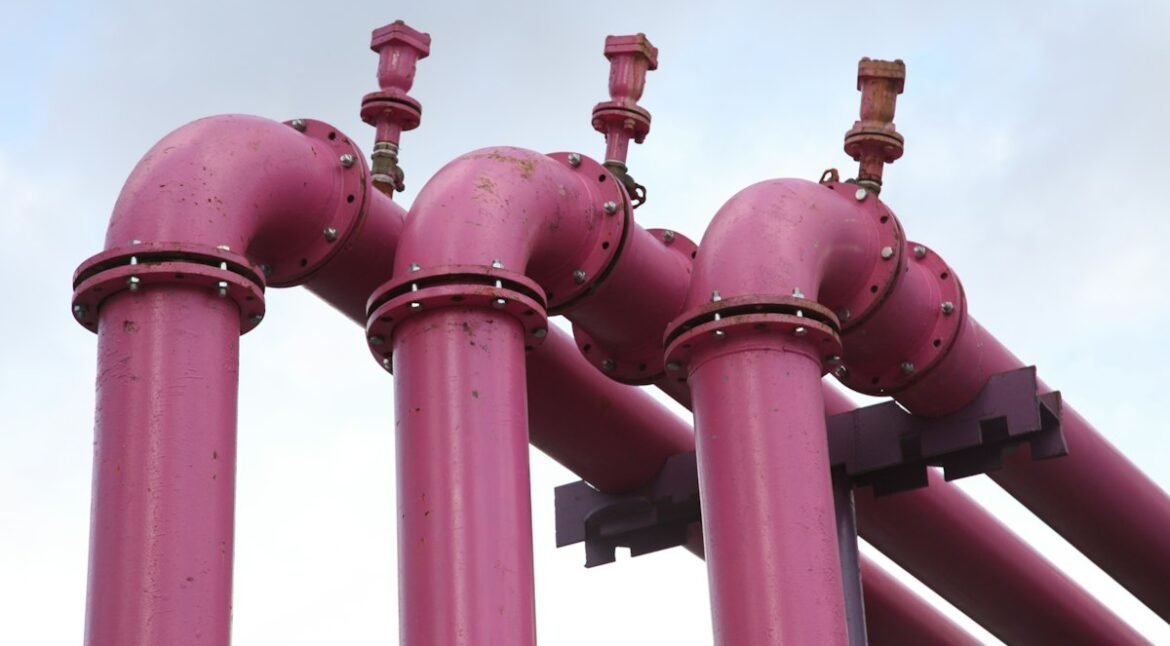
Carbon steel and stainless steel are the two workhorses of industrial piping. Carbon steel is strong, widely available and economical. Stainless steel resists corrosion and keeps its appearance with little maintenance. Choosing between them is rarely about which material is better in general, and almost always about which is better for a particular fluid, environment and budget. This guide sets out the main differences.
What is the difference?
Carbon steel is mainly iron with a small amount of carbon. It has no special alloying for corrosion resistance, so it rusts when exposed to moisture and oxygen unless protected by coatings, linings or corrosion inhibitors.
Stainless steel contains at least about 10.5 percent chromium, which forms a thin, self-healing oxide layer on the surface. This passive layer gives stainless steel its corrosion resistance. Common pipe grades include 304/304L and 316/316L, with duplex grades used for more demanding duties.
Comparing performance
Corrosion resistance
This is the biggest difference. Stainless steel resists corrosion in water, many chemicals, food products and humid atmospheres without additional protection. Carbon steel needs painting, galvanising, internal lining or inhibitors in most wet services, and corrosion allowances are often added to its wall thickness at design stage.
Strength and pressure
Both materials are available in grades suitable for high-pressure service. Carbon steel grades such as ASTM A106 and API 5L are widely used for high-pressure oil, gas and steam lines. Stainless steel pipe to standards such as ASTM A312 also handles high pressures, and its toughness at low temperatures makes it suitable for cryogenic duties where carbon steel becomes brittle.
Temperature
Carbon steel performs well at moderate and elevated temperatures. Austenitic stainless steels keep their toughness at very low temperatures and resist scaling at high temperatures, which widens their useful range.
Hygiene and cleanliness
Stainless steel’s smooth, non-reactive surface is easy to clean and does not contaminate the product, which is why it dominates food, dairy, beverage and pharmaceutical piping.
Cost
Carbon steel pipe is considerably cheaper per tonne, and per metre in most sizes. Stainless steel costs more to buy, but can be cheaper over the life of the installation because it needs less maintenance, may allow thinner walls without corrosion allowance, and lasts longer in corrosive service.
Fabrication
Carbon steel is easy to cut and weld with standard methods. Stainless steel requires clean working practices, appropriate filler metals and protection of the weld area, and tools used on carbon steel should not be used on stainless to avoid contamination.
Typical uses
Carbon steel pipe is common in:
- Oil and gas transmission and process lines.
- Steam and condensate systems.
- Fire protection systems.
- Structural and mechanical applications.
Stainless steel pipe is common in:
- Food, dairy, beverage and pharmaceutical processing.
- Chemical and petrochemical lines carrying corrosive media.
- Water treatment and desalination.
- Cryogenic and low-temperature service.
- Architectural and visible installations.
Thinking about lifetime cost
A useful way to compare is to estimate the total cost over the expected life of the plant: purchase price, fabrication, coatings, inspection, maintenance, downtime and replacement. In corrosive or hygienic service, stainless steel often wins on lifetime cost despite its higher purchase price. In dry, non-corrosive service, carbon steel usually remains the economical choice.
Questions to ask
- What fluid will the pipe carry, at what temperature and pressure?
- Is the environment outside the pipe corrosive, such as coastal or chemical?
- Are there hygiene or product purity requirements?
- How long must the system last, and how easy is maintenance?
Mixing the two
Where carbon and stainless steel pipes meet, use insulating gaskets or dielectric fittings to avoid galvanic corrosion of the carbon steel.
Sourcing pipes
Nefton Exports Industries supplies seamless and welded stainless steel pipes and other steel products with Materials Test Certificates. Send us your requirement for a quotation.